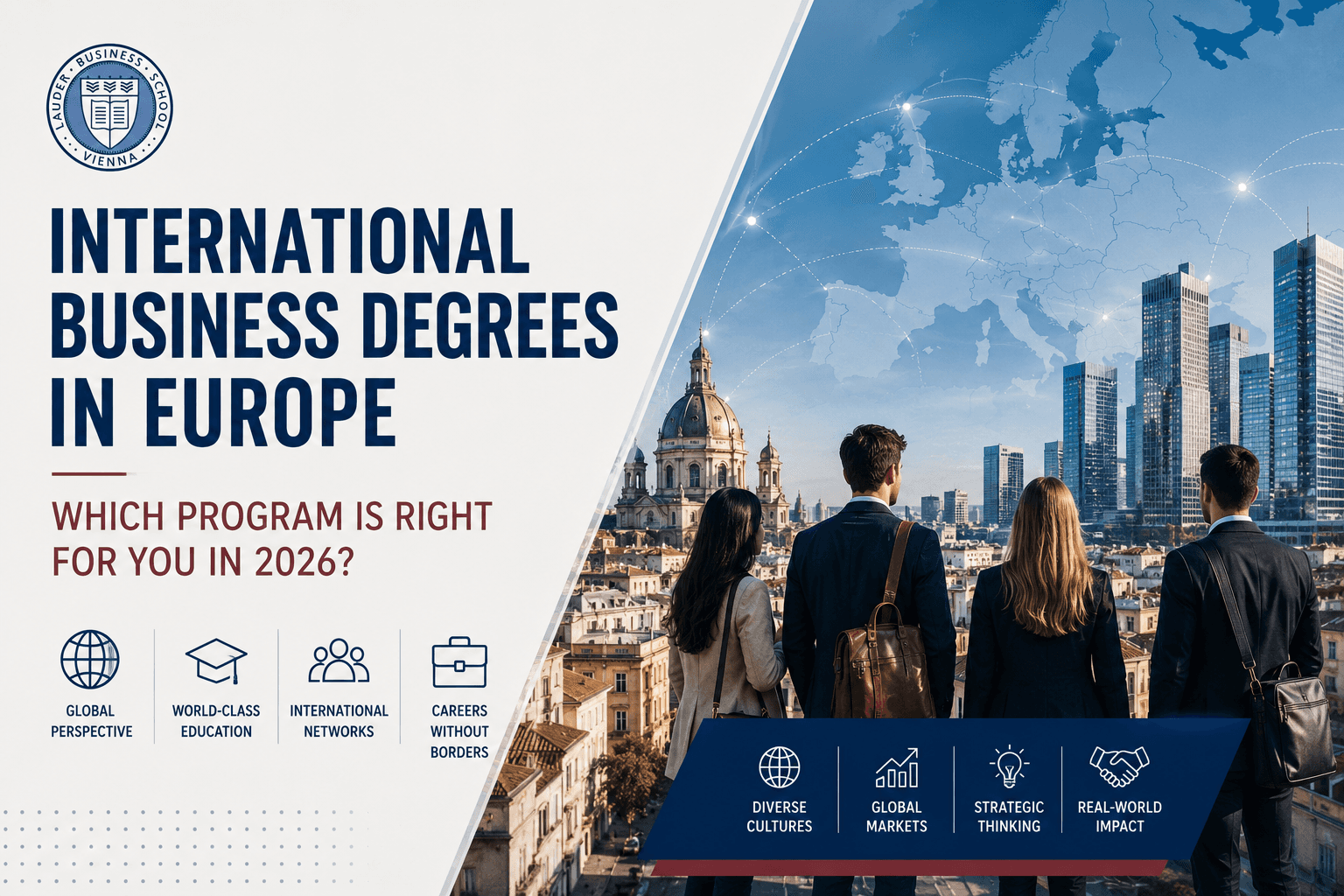

The demand for professionals with genuinely international business capability has continued to grow across sectors, driven by the complexity of global supply chains, the expansion of cross-border commerce, and the increasing expectation that managers at every level can operate effectively across cultural and regulatory environments. For students and professionals evaluating their educational options, international business degrees in Europe offer a compelling combination: rigorous academic frameworks, proximity to multinational business environments, and access to the diverse professional networks that careers in global business require.
Europe's strength as a destination for this kind of education lies not only in its academic institutions but in the commercial and cultural environment that surrounds them. Studying international business in a continent that encompasses dozens of languages, legal systems, and market cultures provides a context for learning that is difficult to replicate elsewhere. This guide examines the main degree pathways available, the institutions worth considering, the skills employers are prioritising in 2026, and the factors that should inform a student's choice.
What Is an International Business Degree?
International business studies is an interdisciplinary field that draws on economics, management, marketing, finance, law, and cross-cultural communication to prepare students for careers that span multiple markets. Unlike a general business degree focused primarily on domestic commercial environments, an international business program is built around the assumption that students will work across borders, manage diverse teams, navigate unfamiliar regulatory frameworks, and build commercial relationships in cultures different from their own.
Core subjects typically include global market analysis, international trade theory and practice, strategic management in multinational contexts, cross-cultural communication and negotiation, supply chain and logistics across borders, international financial management, and digital business in global markets. The interdisciplinary character of the field means that students develop both analytical frameworks and practical competencies, and the most effective programs reinforce both through industry-connected projects, international exposure, and faculty who bring current professional experience into the classroom.
The relevance of this field in 2026 is not in question. Globalisation has not reversed; it has shifted in form. Supply chains have become more strategic, digital trade has expanded dramatically, and the management of internationally distributed teams has become a standard rather than exceptional leadership requirement. Graduates with genuine cross-border business fluency are in demand across consulting, financial services, technology, logistics, consumer goods, and the public sector.
Bachelor's, Master's, or MBA: Understanding the Differences
Bachelor's Degree in International Business
A bachelor's degree in international business is designed for students entering higher education who want to build a broad foundation in global commerce alongside the core disciplines of management, economics, and marketing. Programs typically run for three to four years and combine academic frameworks with practical projects, case studies, and, in the stronger programs, direct industry exposure through internships or company partnerships.
The bachelor's pathway suits students who are at the beginning of their professional formation and want a degree that opens doors to entry-level roles in international marketing, business development, trade operations, and management traineeship programs. It is also the natural foundation for those who intend to continue to a master's or MBA later in their careers.
At Lauder Business School in Vienna, the International Business Administration (IBA) program is a bachelor's-level degree taught entirely in English to a multicultural student cohort. The curriculum integrates core business disciplines with applied projects and cross-cultural business analysis, preparing graduates for entry-level and early management roles in international organisations.
Master's Degree in International Business or Management
A master's degree is the appropriate next step for graduates who want to specialise, deepen their analytical capability, or develop leadership and strategic management skills before moving into more senior roles. It is also a common pathway for professionals who completed an undergraduate degree in a different field and want to reorient toward international business or management.
Master's programs in international business or management typically run for one to two years and offer a more focused curriculum than bachelor's programs, with greater depth in strategic thinking, leadership development, and applied research. The quality of peer learning at this level is also more pronounced, since cohorts tend to include students with diverse academic and professional backgrounds who bring different perspectives to shared academic work.
The International Management and Leadership (IML) program at LBS is a master's-level program designed for students who want to develop strategic management and leadership capability in an international context. It is taught in English in a small-cohort environment that enables close faculty engagement, with a curriculum built around the practical challenges of managing across cultures, sectors, and organisational structures.
MBA Programs
An MBA is a graduate business qualification designed for professionals who already have meaningful work experience and want to develop broader management capability, transition into new sectors, or prepare for senior leadership roles. The typical MBA candidate has between two and seven years of professional experience and is looking for a program that combines strategic and financial frameworks with a strong professional network and career development infrastructure.
MBA programs are available in full-time, part-time, and online formats, each with different implications for cost, flexibility, and professional continuity. For working professionals who want to study without stepping away from their careers, online and part-time formats have become increasingly credible options, supported by improvements in digital learning quality and shifting employer attitudes toward flexible credentials.
The LBS Online MBA is a fully online program taught in English, designed specifically for working professionals. It admits students on a rolling monthly basis, is self-paced, and is structured around the needs of students managing full-time employment alongside their studies. It is accredited by AQ Austria and ACBSP, providing internationally recognised credentials for graduates pursuing careers across sectors and geographies.
Which Skills Employers Will Look for in 2026
Understanding what employers actually value from graduates of international business programs is essential context for choosing between degrees, institutions, and specialisations. The data from major workforce research bodies points in a consistent direction.
The World Economic Forum's Future of Jobs Report 2025 identifies analytical thinking as the single most in-demand core skill among employers globally, cited by 70 percent of surveyed companies as a priority. The same report ranks AI and big data literacy among the top five fastest-growing skills, while estimating that 39 percent of existing worker skill sets will be significantly transformed by 2030. Leadership and social influence rank consistently in the top ten skills that organisations expect to become more important over the coming five years.
LinkedIn's 2024 Workplace Learning Report found that the skills required for jobs have changed by approximately 25 percent since 2015 and are expected to change by at least 65 percent by 2030, driven by the adoption of generative AI tools and the restructuring of commercial teams around data-driven workflows. Intercultural communication and cross-functional collaboration appear consistently in LinkedIn's most in-demand professional skills rankings, reflecting the internationalisation of teams across sectors.
McKinsey's research on the future of work underlines the increasing premium on human skills that automation cannot replicate: creative problem-solving, ethical judgment in complex situations, and the ability to build trust across culturally diverse teams. For students pursuing international business degrees in Europe, these findings translate into a specific set of competencies that the strongest programs actively develop:
• Leadership capability applicable across cultural contexts, including the ability to motivate, direct, and develop teams whose members operate from different professional and cultural backgrounds.
• AI literacy and data-driven decision-making: the ability to understand what AI tools can and cannot do, interpret data outputs critically, and integrate quantitative insights into strategic decisions without outsourcing judgment entirely to algorithms.
• Intercultural communication and negotiation, built through direct experience with multicultural peer groups rather than through theory alone.
• Adaptability and cognitive flexibility, increasingly valued as the pace of market and technological change accelerates and the half-life of specific knowledge shortens.
• Sustainability mindset, as ESG considerations have moved from the margins of corporate strategy to the centre, and graduates who can navigate the regulatory, commercial, and ethical dimensions of responsible business are in growing demand.
Where to Pursue International Business Degrees in Europe: Popular Study Destinations
Europe's diversity of academic traditions, business environments, and living contexts makes it an unusually rich region for international business studies. Each major destination offers a distinct combination of advantages.
Austria
Austria's position at the centre of European business geography, its growing English-language academic infrastructure, and its Central European access make it a strong destination for students interested in international business with a European and global dimension. Vienna in particular offers proximity to multinational regional headquarters, international institutions, and a startup ecosystem, alongside a quality of life that is consistently ranked among the highest in the world.
Among the English-language business schools in Vienna, Lauder Business School stands out for its combination of internationally oriented programs, small cohort environment, and practical business curriculum. LBS offers degrees at bachelor, master, MBA, and Executive MBA level, all taught in English, making it a natural starting point for international students considering business education in Austria.
Germany
Germany's scale as Europe's largest economy and its strength in manufacturing, technology, automotive, and financial services make it a natural destination for students targeting careers in those sectors. German business schools range from large research universities with strong domestic employer recognition to private institutions with more internationally oriented profiles. The language of instruction is increasingly English at the graduate level.
The Netherlands
The Netherlands has a well-established English-language higher education tradition and hosts a significant number of multinational European headquarters, particularly in Rotterdam and Amsterdam. Dutch business schools are often strong in logistics, sustainability, and international trade, reflecting the country's commercial heritage.
France
France's grandes ecoles tradition produces some of Europe's most internationally recognised business graduates. Institutions like ESCP Business School and ESSEC have long histories of producing internationally mobile professionals, and Paris functions as a significant hub for luxury, consulting, and financial services careers.
Italy
Italy's combination of cultural richness, industry diversity, and strong business schools, particularly Bocconi University in Milan, makes it an attractive destination for students with interests in fashion, design, finance, and consumer goods. Milan's commercial ecosystem gives students access to a concentration of European and global companies in a compact professional environment.
Across all these destinations, Europe's Erasmus+ programme provides funded mobility opportunities for enrolled students, allowing study abroad periods and international exchanges that extend the geographic and professional reach of a European degree beyond the country of enrollment.
Universities Offering International Business Degrees in Europe
The range of institutions offering international business programs in Europe is broad, and the differences between them are meaningful. The right institution depends not only on rankings but on the kind of learning environment, career focus, and student experience a program delivers.
WU Vienna
WU Vienna is well suited to students who prioritise institutional scale, domestic Austrian brand recognition, and access to a large alumni network. Its programs are recognised across Central Europe and combine business and economics depth with well-developed international partnerships. Class sizes are larger, which shapes the character of the student experience toward greater independence and peer diversity.
Bocconi University (Milan)
Bocconi is the strongest choice for students targeting careers in finance, banking, or management consulting in the European market, particularly in Italy and Southern Europe. Its reputation in quantitative business disciplines and its proximity to Milan's financial and fashion industry ecosystem make it a compelling option for analytically oriented students with European career ambitions.
IE Business School (Madrid)
IE is particularly well-suited to students with entrepreneurial ambitions or an interest in innovation, digital business, and technology strategy. Its practice-oriented culture, diverse international cohort, and strong connections to the startup and venture capital community in Spain and beyond distinguish it from more traditionally academic European institutions.
ESCP Business School
ESCP is the right choice for students who specifically want a pan-European educational experience. Its multi-campus structure allows students to study in two or more countries within a single program, building the kind of documented cross-border fluency that internationally oriented employers value. It suits students who want Europe itself to be the classroom.
ESSEC Business School
ESSEC is best known for its strength in luxury management, retail, and international negotiations, making it a distinctive choice for students targeting those specific sectors. Its dual campus in France and Singapore also gives it an international reach that extends beyond Europe into Asian markets.
The distinction between large research-oriented universities and smaller practice-focused institutions is worth examining carefully. Large universities offer scale, brand recognition, and research depth. Smaller institutions tend to offer smaller cohorts, more direct faculty access, more agile curriculum development, and a learning environment where individual students are not anonymous. Neither model is universally superior; the right choice depends on how a student learns most effectively and what their career requires.
Featured Programs at Lauder Business School
Lauder Business School in Vienna offers three English-language programs designed for students at different stages of their academic and professional development, all sharing a common orientation toward international business, practical learning, and multicultural engagement.
International Business Administration (IBA)
The IBA program is a bachelor's-level degree in international business, taught entirely in English to a multicultural student cohort. The curriculum integrates core business disciplines with applied projects and cross-cultural business analysis, preparing graduates for entry-level and early management roles in international organisations. Students develop analytical and interpersonal skills in an environment that reflects the diversity of the global professional world from their first semester.
International Management and Leadership (IML)
The IML program is a master's-level qualification in international management and leadership, designed for graduates who want to develop strategic capability and prepare for leadership roles in international contexts. The program is taught in English in a small-cohort environment that enables close faculty engagement and peer collaboration. Its curriculum is built around the practical challenges of leading across cultures, sectors, and organisational structures, with a strong emphasis on applied learning and individual development.
Online MBA
The Online MBA is a fully online, self-paced graduate business program designed for working professionals who want to advance their management credentials without interrupting their careers. Taught in English, it admits students on a rolling monthly basis and is structured to accommodate students studying across different time zones and professional commitments. The program includes embedded industry certifications and is delivered by faculty with active professional experience across finance, marketing, sustainability, and strategy.
How to Choose the Right International Business Degree in Europe
The range of programs and institutions available makes systematic evaluation essential. Several factors consistently distinguish programs that deliver on their promises from those that do not.
• Career goals: The most important starting point. A student targeting a role in international marketing needs a different program than one aiming for supply chain management or financial consulting. Match the specialisation and curriculum to the specific role rather than to a general aspiration.
• Study format: Full-time campus-based study, part-time attendance, and online delivery each involve different trade-offs between depth of immersion, flexibility, cost, and professional continuity. Online programs have closed much of the experiential gap with campus-based alternatives for many student profiles.
• Accreditation: Internationally recognised accreditation from bodies such as AACSB, EQUIS, ACBSP, or AMBA is the baseline quality signal for programs whose graduates intend to work internationally. Verify accreditation status directly with the awarding body.
• International exposure: The proportion of international students in the cohort, the geographic distribution of alumni, and the availability of exchange or mobility opportunities all shape the international dimension of a program's value.
• Career services and industry connections: Proactive career support, employer relationships, internship infrastructure, and alumni engagement throughout the program distinguish the strongest programs from the average.
• International cooperation framework: The strength and activity of a school's international partnerships determines the real geographic reach of the student experience and the professional network it builds.
Frequently Asked Questions
Is an international business degree worth it in 2026?
The evidence points consistently toward yes. Globalisation has not retreated; it has become more complex. Companies operating across borders need professionals who can navigate regulatory environments, manage diverse teams, build commercial relationships across cultures, and analyse global market dynamics. Remote and internationally distributed work has also expanded the range of roles that require cross-border business fluency, including many that previously had a primarily domestic character. Employer demand for graduates with genuine international business skills has grown, and programs that develop those skills through direct multicultural exposure, applied projects, and international faculty tend to produce graduates who can demonstrate that capability from day one.
Can I study international business in English in Europe?
Yes, and the number of options has expanded substantially over the past decade. The Netherlands has one of the highest proportions of English-language programs in European higher education. Austria's private business schools, particularly in Vienna, offer programs taught entirely in English to internationally diverse cohorts. France's grandes ecoles have expanded their English-language offerings significantly at both bachelor and master levels. Among the institutions offering fully English-language international business education in Vienna, Lauder Business School provides IBA, IML, and Online MBA programs designed specifically for international students and taught by faculty drawn from active industry roles.
What careers can I pursue with an international business degree?
The career pathways are broad. Common roles include International Marketing Manager, Business Development Manager, Management Consultant, Supply Chain and Logistics Specialist, Project Manager in multinational environments, Trade Analyst, and Export Manager. Entrepreneurial pathways are also common, particularly for graduates who combine business foundations with specific sector expertise. The IBA is well-suited for entry-level and early management roles; the IML prepares graduates for leadership and strategic management positions; the Online MBA targets mid-career professionals pursuing senior roles or significant career transitions.
Conclusion: Choosing the Right Pathway into International Business
International business degrees in Europe offer a well-developed range of options for students at every stage of their academic and professional development. The combination of rigorous academic frameworks, proximity to genuinely international business environments, access to Erasmus+ mobility opportunities, and the multicultural character of European campus life makes this region a strong choice for students whose careers will require them to operate across borders.
The right program depends on where you are in your development, what your career goals require, and the kind of learning environment where you will thrive. A bachelor's program is the right foundation for students entering higher education who want to build broad international business competency. A master's program is suited to graduates and early-career professionals seeking specialisation and leadership preparation. An MBA serves mid-career professionals looking to expand their strategic capability or transition into new roles.
The first step is identifying which career stage and study format fit your situation. From there, the program that matches those criteria is the one worth exploring in depth.
Students interested in English-language business education in Vienna can explore each pathway directly: the International Business Administration bachelor's program for those building their foundations, the International Management and Leadership master's program for those preparing for leadership roles, and the Online MBA for working professionals ready to advance their careers. Each program page includes full curriculum details, admission requirements, and contact information for the admissions team.
Related Blogs